About us
FTDNA - Group 1c - Ballard Y. Origin.
"Pre Roman Briton and Northern Gaul."
R-S1194 > R-CTS4528 > R-S14328 > R-S1211 > R-S1196 > R-Y22442 > R-S1205+ (12th Aug 2023)
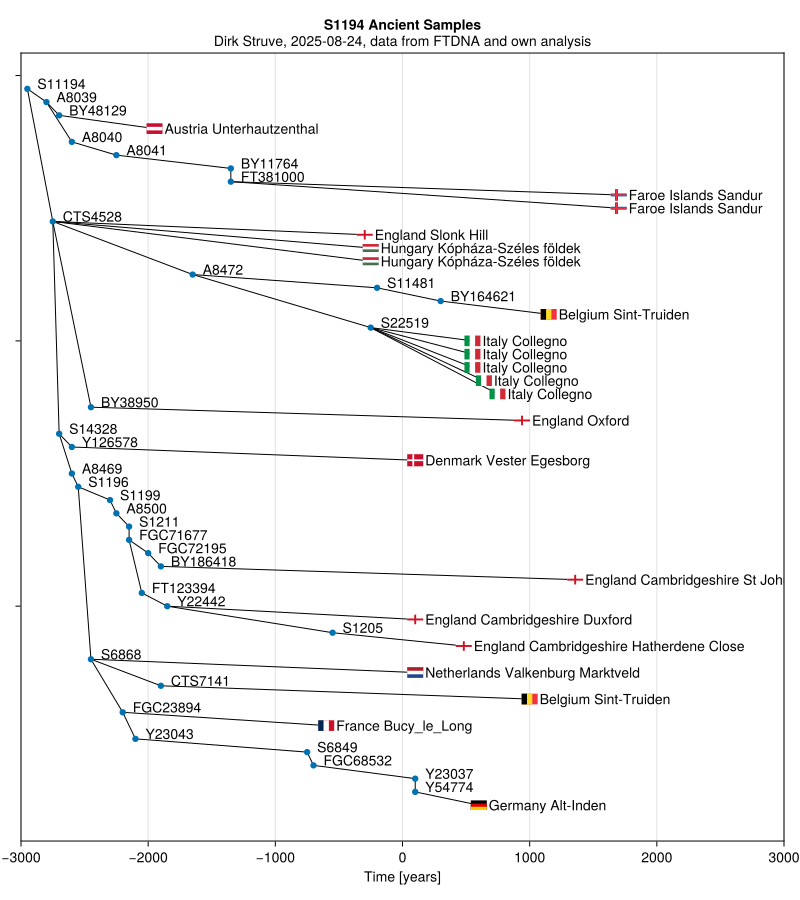
R-S1194 the brother Haplotype to the Prolific R-U106 & R-P312 Haplogroups under R-L151
Comparitive ancient burial animations for the three brother haplogroups
U106: http://www.projectory.de/genetics/U106_migration.mp4
U106 - very early expansion into Denmark - no or very little Bell Beaker activity in France and Spain - strong growth in Denmark - migration to England during the Migration period, but also to South-East-Europe and Norway/Sweden continuing throughout the Viking Age - most likely recent Anglo-Saxon culture group.
P312: http://www.projectory.de/genetics/P312_migration.mp4
P312 - massive expansion into Southern Europe and the British Isles during Bell Beaker times - continuing population growth - migration to Scandinavia starting with the Viking Age - most likley recent Norman culture group.
S1194: http://www.projectory.de/genetics/S1194_migration.mp4
S1194 - scarcity of samples - basically most of them staying somewhat close to the English Channel - most likely, recent Belgae culture group.
[Mapping by Dirk Struve 18 July 2025. (R-S1194 FTDNA Group participant)].
Important time periods.
2800 - 1800 - bce - Bell Beaker Culture.
500 - bce - Brutus arrival in Britain. ;-)
400 - 200 bce - Belgae in northern Gaul later migrations into Britain.
300 - 600 ce - Migration Period.
800 - 1050 ce - Viking Age.
The evidence so far demonstrates a good overal coverage of excavated archaeological burial sites thus far, the brother haplogroup's (U106 & P312) being found widespread in Europe and reaching Briton. The "Father" Haplotype R-L151 is mainly found (but not exclusively) from ancient burials, in the areas of what we now know as the Czech Republic (Bohemia) the stronghold of the more recent "Celtic" Boii tribe.
R-S1194 apears in the region much later than U106 & P312, apearing circa 600 BC in northern Gaul and later into Briton circa 200 BC (Pre Roman).
Adrian Ballard of Bristol, England. - test BIGY700 - positive for R-S1194
R-M269
│
└── R-L151
│
├── R-P312 (Prolific European - Celt Generalisation)
│
├── R-U106 (Prolific European - Germanic Generalisation)
│
└── R-S1194 (Ballard ancester Y Gene found below this "Rare" Gene line)
│
└── R-CTS4528
│
└── R-S14328 - Ancient Burials - Cambridgshire / Catuvellauni tribe & Pocklington / Parisi tribe.
│
└── R-S1196
│
└── R-S1211
│
└── + other downstream branches.
FTDNA - Group 2d - Ballard Y. Origin.
"NORMAN" - Bosc-le-Hard
SNP - R1b-P312 > R-FGC36918 + (30th October 2022)
FTDNA - Group 2c - Ballard Y. Origin.
WORCESTERSHIRE, ENGLAND
SNP - R1b-P312 > R-CTS4466 + (35 July 2026)
Richard Ballard 23&me R-L21+ positive (BIGY700 resolution required) Abbott of Evesham Pedigree. Crowle, Worcestershire. sponsorship offers possible.
Ballard - 831280 - R-BY137705
Ballard - 103589 - R-FTB34515
Group Xe - Bellardi / Ballard Y. Origin.
"Lombard" ??
SNP - G-L14
Group 4 - Bollart/Ballard Y Origin.
Dublin, Ireland / Netherlands (pos Lombardy)"
Group 2e Rib-P312 > R-FT112494
Testers;
1. Bollard - IN52381
2. Ballard - 351388
The Bollard/Ballard family found in Ireland having taken BigY700 test. We find that the closest Ancient Burial data confirms a match In Groningen, Netherlands dated 1037 - 1043 AD this is consistent with the Ballards found in this area during this period, a branch is known to have later settled in Dublin, Ireland.
Further we find ancient burial matches in Turin, Lombardy territory, dated 500 - 700 BC this could be a signal that relates to the Bellardi of Lucca merchants that came to England, France and Netherlands during this period and a little after 11th & 12th Century or could be another in-dependent line.
Earlier ancient burials dated 770 - 544 BC in France could be an indicator of a Lombard confederate signal.
In summary I would highly suspect that the Ballard/Bollards in this Haplogroup can be traced back to the Netherlands in the first instance and very Likely further into Lombardy.
subsequent investigations into the Bellardi of Lucca and the Bollards of the Netherlands does lend its self to those being one and the same people, but research is ongoing.