About us
Chadwell patriarchs. We had originally believed it was possible that all Chadwell males would trace back a single patriarch, most likely in England. Several academic studies (King, 2009; Pomery, 2010) have theorized that surnames which aren't very common in the United Kingdom today will usually turn out to have a single, patriarch ancestor within a genealogically meaningful timeframe. In addition, certain types of surnames (for example, those named after a geographic location) will be more likely to have a single, shared ancestor than surnames formed in other ways (for example, those named after a trade, such as "Smith" or "Taylor."). The Chadwell surname is not very common in the United Kingdom today. Although Chadwell matches the characteristics of a surname likely to descend from a single patriarch, we have learned through y-DNA testing that Chadwells do not descend from a single male patriarch. It should be noted that most surnames do not have a single patriarch. Even those surnames which originally had a single patriarch usually will have new "lines" established over time due to events such as adoptions, etc.
Chadwell lineages. Y-DNA testing has shown us that there are at least three distinct Chadwell lineages. One line is in Haplogroup R and the other two are in Haplogroup I. A haplogroup is a genetic population of a large group of people, analogous to a huge clan (like Celts or Vikings). Haplogroup R is the most common male haplogroup in Great Britain. By contrast, Haplogroup I is the most common haplogroup among Scandinavian men; however, elements of Haplogroup I are also believed to have been present in Great Britain for about 3,000 years. Within each of the three distinct lineages, Chadwell men who have tested match each other very closely. Thus, our information so far points to three different Chadwell patriachs.

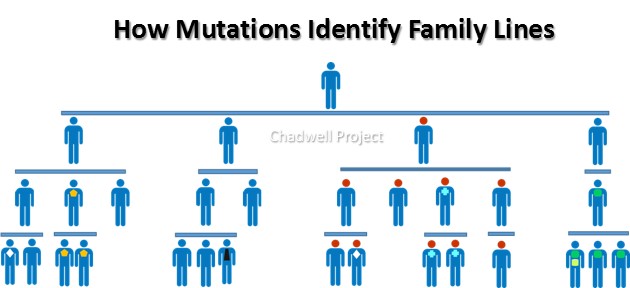
Distinguishing between lineages. Men usually inherit their father's y-DNA identically; however, occasionally a mutation occurs. The mutations along a line of descent are what enable us to identify separate branches in the family tree. An important concept to keep in mind when comparing your y-DNA marker differences to your matches is that the marker distances between men don't tell the whole story. In the image below, different colored shapes on the blue men represent deviations to the patriarch's y-DNA. It's entirely possible that two men descending from different lineages (e.g., the two "white-diamond" men below) could coincidentally have the same mutation in a random marker (typically a fast-moving marker), but that doesn't make them more closely related. For example, the "red head/white diamond" man has a distance (i.e., difference) of 1 from his red-head brother. Coincidentally, he also has a distance of 1 from his white-diamond 2nd cousin, but that doesn't mean he's as closely related to his 2nd cousin as he is to his own brother.
Chadwell Distinguishing Lineage Markers Identified To Date. Our test results are beginning to show distinguishing characteristics between different Chadwell lineages. Big Y testing has confirmed this also. For example, some identifying markers for those Chadwells in Haplogroup R are described below.
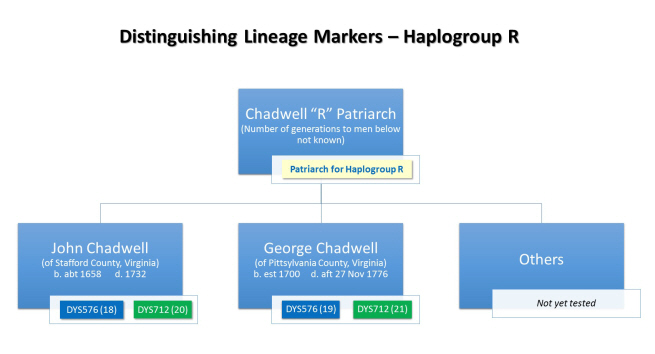
All tested known descendants of George Chadwell of Pittsylvania County have the same two distinctive y-DNA markers not shared by any other Chadwells tested so far. This suggests that George Chadwell himself may have carried those two markers and passed them on to his sons, who in turn passed them on to their sons, etc. They are:
-
DYS576=19 (vs 18). DYS576 is a fast-moving marker. (All fast-moving markers are color-coded in red on the y-DNA Results charts.)
- DYS712=21 (vs 20). DYS712 is a medium-moving marker. All tested descendants of George Chadwell of Pittsylvania have a 21 vs 20 for this marker.
The y-DNA test results for George Chadwell descendants came from men descended from his two sons, through five of his grandsons, through five of his great grandsons, through six of his great great grandsons:
-
Son: John Chadwell of Pittsylvania County, Virginia, 1720-1794
- Grandson: George Chadwell, 1783-1860
- Great Grandson: John A Chadwell, b. 1820
- Great Great Grandson: James Paul Chadwell, b. 1846
- Grandson: David C Chadwell, 1790-1872
- Great Grandson: William P Chadwell, b. 1816
- Great Great Grandson: John B Chadwell, b. 1849*
- Son: David Chadwell of Tazewell County, Tennessee, 1733-1833
- Grandson: David Chadwell, Jr, 1776-1862
- Great Grandson: Pleasant Duff Chadwell, 1808-1884
- Great Great Grandson: John Breckenridge Chadwell, b. 1839
- Great Great Grandson: Andrew Johnson Chadwell, b. 1857
- Grandson: John Chadwell, Jr, 1771-1840
- Great Grandson: William Edward Chadwell, 1802-1859
- Great Great Grandson: George F Chadwell, 1838-1919
- Grandson: Alexander Hamilton Chadwell, Sr, 1783-1868
- Great Grandson: Golvin Timothy Chadwell, 1823-1902
- Great Great Grandson: Alexander Charles Chadwell, 1864-1911
The distinguishing markers carried by all tested George Chadwell descendants are an example of how mutations along a line of descent enable us to identify different family lineages.
*One "sprig" off the John Chadwell of Pittsylvania branch also has a unique y-DNA signature. All three tested descendants of John B Chadwell b. 1849 have an identifying "10" in marker DYS385a, whereas all others have an "11."
Haplogroup results. A haplogroup is a genetic population of a large group of people who share a common ancestor, analogous to a huge clan (like Celts or Vikings). It can be viewed as a tree ("haplotree"), with many limbs and branches. Our Chadwell overarching haplogroups are "R" and "I." Tests to further refine your haplogroup classification are available, and there are experts who can advise you which tests might be best for you. As of now, all Chadwell males within Haplogroup R who have taken advanced tests have been classified as belonging to "R-FGC19972." The progression, based on level of testing, is R-M269 > R-L48 > R-Z326 > R-CTS2509 > R-FGC19972. Chadwell males in Haplogroup I are further classified as either Haplogroup "I-M233" or Haplogroup "I-M253."